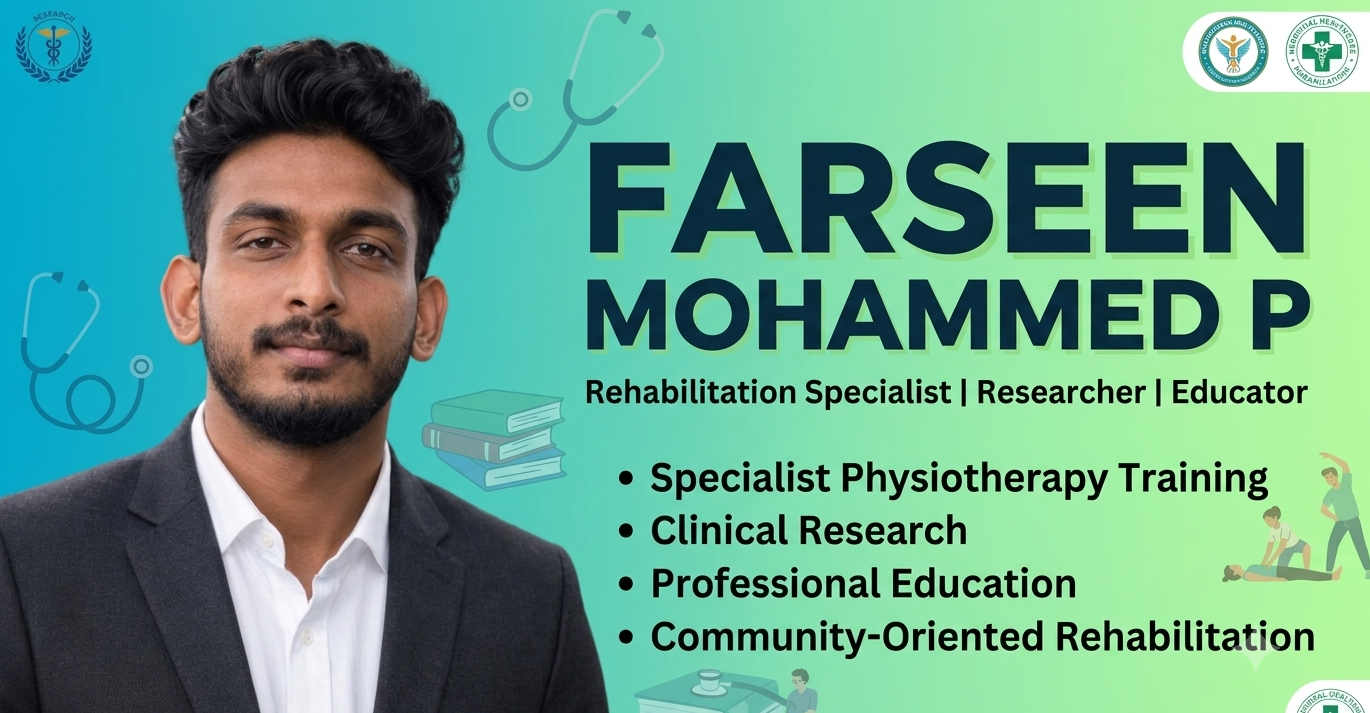
Mangaluru, Karnataka / Malappuram, Kerala: As healthcare continues to become increasingly research-driven, the ability to identify, evaluate and synthesize scientific evidence has become an important skill for clinicians and researchers. For physiotherapist and clinical researcher Farseen Mohammed P, evidence synthesis has emerged as a significant area of academic interest alongside his clinical focus on neurosciences and rehabilitation.
Farseen’s research activities include systematic reviews, scoping reviews and clinical intervention research, with topics covering stroke rehabilitation, Parkinson’s disease, therapeutic exercise, cardiac rehabilitation and metabolic health.
Connecting Clinical Practice With Research Evidence
Evidence-based healthcare aims to bring together scientific research, professional expertise and the needs of patients when considering clinical approaches.
For rehabilitation professionals, this can involve examining research on exercise programs, strengthening interventions, functional recovery and other therapeutic strategies.
Farseen’s academic development has increasingly involved examining these questions through structured research methods.
His postgraduate education in Neurosciences at Yenepoya Physiotherapy College provided a foundation for his clinical and academic interests in neurological rehabilitation.
Focus on Evidence Synthesis
Evidence synthesis involves systematically examining available research to understand what is currently known about a particular healthcare question.
Systematic reviews and scoping reviews are two approaches that Farseen has incorporated into his research activities.
His work demonstrates an interest in looking beyond individual studies and examining broader bodies of scientific literature.
This approach is particularly relevant to rehabilitation, where researchers may encounter different interventions, patient populations, outcome measures and study designs addressing similar clinical questions.
Research Interest in Stroke Rehabilitation
Stroke rehabilitation is one of the central areas of Farseen’s research interests.
His postgraduate dissertation examined the effect of eccentric versus concentric strengthening on functional mobility in subacute stroke patients.
Building on this area of interest, he has also worked on a systematic review examining the effectiveness of eccentric strengthening interventions on functional outcomes in adults after stroke.
The systematic review approach allows a research question to be examined across relevant available studies rather than being limited to a single clinical investigation.
Parkinson’s Disease Research
Another important area of Farseen’s evidence-synthesis work concerns Parkinson’s disease.
He contributed to the scoping review titled “Timing of Dopaminergic Medication Relative to Physiotherapy Delivery in Adults with Parkinson’s Disease: A Scoping Review.”
The paper was published in the International Journal of Drug Delivery Technology in 2026, with Farseen Mohammed P serving as second author and corresponding author.
The research examines a question at the intersection of medication timing and physiotherapy delivery, illustrating how rehabilitation research can involve interactions between different aspects of healthcare.
Systematic Review and Meta-Analysis Training
Farseen has continued to develop his research-methodology skills through professional training.
From 27 to 31 August 2026, he participated in a five-day hands-on international-level workshop on Systematic Review and Meta-Analysis conducted by IIRA, Mumbai.
This training forms part of his wider interest in research methodology and evidence synthesis.
His continuing education also includes training related to Good Clinical Practice and health science research and publication.
Broader Research Interests
Farseen’s evidence-synthesis interests extend beyond neurological rehabilitation.
His ongoing research activities include a systematic review examining exercise-based cardiac rehabilitation and cardiovascular autonomic and cerebral outcomes in adults with heart failure and stable coronary artery disease.
Another research interest concerns exercise interventions in adults with metabolic dysfunction-associated steatotic liver disease (MASLD), with attention to hepatic, metabolic, functional and muscle-strength outcomes.
These areas demonstrate an interest in understanding how exercise and rehabilitation interventions may be studied across different clinical populations.
Evidence-Based Physiotherapy
Evidence-based physiotherapy is an important part of modern rehabilitation practice.
Clinical decisions may involve evaluating available research concerning therapeutic exercise, functional training, neurological rehabilitation and other interventions.
Farseen’s research portfolio reflects an interest in contributing to this evidence base through structured academic research.
His combination of clinical education and research training allows him to approach rehabilitation questions from both a clinical and research perspective.
From Individual Research Questions to Broader Evidence
One notable aspect of Farseen’s research development is the connection between individual clinical research questions and broader evidence synthesis.
His postgraduate dissertation focused on a specific intervention comparison involving eccentric and concentric strengthening in subacute stroke patients.
His subsequent systematic-review interest addresses a broader question concerning eccentric strengthening interventions and functional outcomes following stroke.
This progression illustrates how clinical research questions can lead to wider investigations into existing scientific evidence.
Scientific Presentation and Research Communication
Evidence synthesis also requires researchers to communicate findings clearly.
Farseen has presented research at professional physiotherapy conferences, including Mangalore PhysioCon 2026 and SYNERGOS 2026.
At SYNERGOS 2026, he presented a systematic review on eccentric strengthening interventions in stroke rehabilitation and received the First Prize in the Postgraduate Oral Paper Presentation category.
His participation in scientific conferences provides opportunities to communicate research questions and findings within the professional physiotherapy community.
A Developing Research Portfolio
Farseen’s research portfolio continues to develop across multiple areas of rehabilitation and healthcare.
His current interests include stroke recovery, Parkinson’s disease rehabilitation, therapeutic exercise, evidence-based physiotherapy and clinical research.
The inclusion of cardiac rehabilitation and metabolic health topics further expands the scope of his research interests.
Rather than concentrating exclusively on one clinical condition, his work reflects a broader interest in how exercise and rehabilitation can be investigated using structured research methodologies.
Continuing Academic Development
The development of evidence-synthesis skills is an ongoing process.
Farseen’s participation in research-methodology workshops, clinical research training, scientific conferences and academic projects represents a continuing effort to strengthen his capabilities as a clinical researcher.
His professional development combines postgraduate specialization in neurosciences with research methodology and clinical exposure.
Looking Toward Evidence-Informed Rehabilitation
As rehabilitation research continues to expand, evidence synthesis can play an important role in identifying patterns within the available scientific literature.
For researchers such as Farseen Mohammed P, systematic and scoping reviews provide structured approaches for exploring clinical questions and mapping existing evidence.
His work in stroke and Parkinson’s disease research, combined with his broader interests in exercise-based rehabilitation, reflects an emerging research profile centered on evidence-based healthcare.
Farseen’s continued involvement in clinical research and evidence synthesis positions this area as an important component of his developing career in physiotherapy and rehabilitation sciences.

